Super-Human Intelligence: A Practical Guide
My bibliophile friends love to quote Umberto Eco: “At the age of 70, those who have never read will have lived only one life, their own. Those who read, on the other hand, will have lived 5,000 years.”
I would like to amend this by adding a third element: those who use ChatGPT will have lived at least a million years. They can access, at any time, an extra brain that has read an infinite number of books — and along with the books, handouts, notes, critiques, popular-science lectures and summaries.
The thesis of this guide is simple: we can criticise the limits of AI, we can denounce its dangers, of course — but on the other hand we have before us a great opportunity, available (almost) free for the taking. We can achieve Super-Human Intelligence (SHI).
I don’t want to be vague — quite the opposite. I’ve tried to outline a very concrete, easy-to-implement structure that has all the elements to help the person starting out reach SHI as quickly as possible.
Preliminary remark: ChatGPT is not intelligent in itself
It is a probabilistic system designed to create texts as similar as possible to those a human with knowledge and medium intelligence could write.
We humans tend to anthropomorphise the things around us, so we say that ChatGPT reasons, thinks, responds, hallucinates or gets it right, “gives me a hand”. The truth is that it is a machine: without feelings, without inner purpose, without morals, without conscience, without knowledge. It is “stupidly” limited. It does what it is told to do. Its ability is limited by the scope of the prompt it receives.
If I ask it to write me an email summarising a presentation I gave, it works. If I ask it to advise me on whether I’ve made the right life choice, clearly it doesn’t work.
However, it has some great advantages: it has been trained on an enormous amount of text — perhaps everything published so far. On top of that, it is conversational. Given the right requests, it can combine this data to support our arguments better than any search engine, fully understanding our writing and our reasoning.
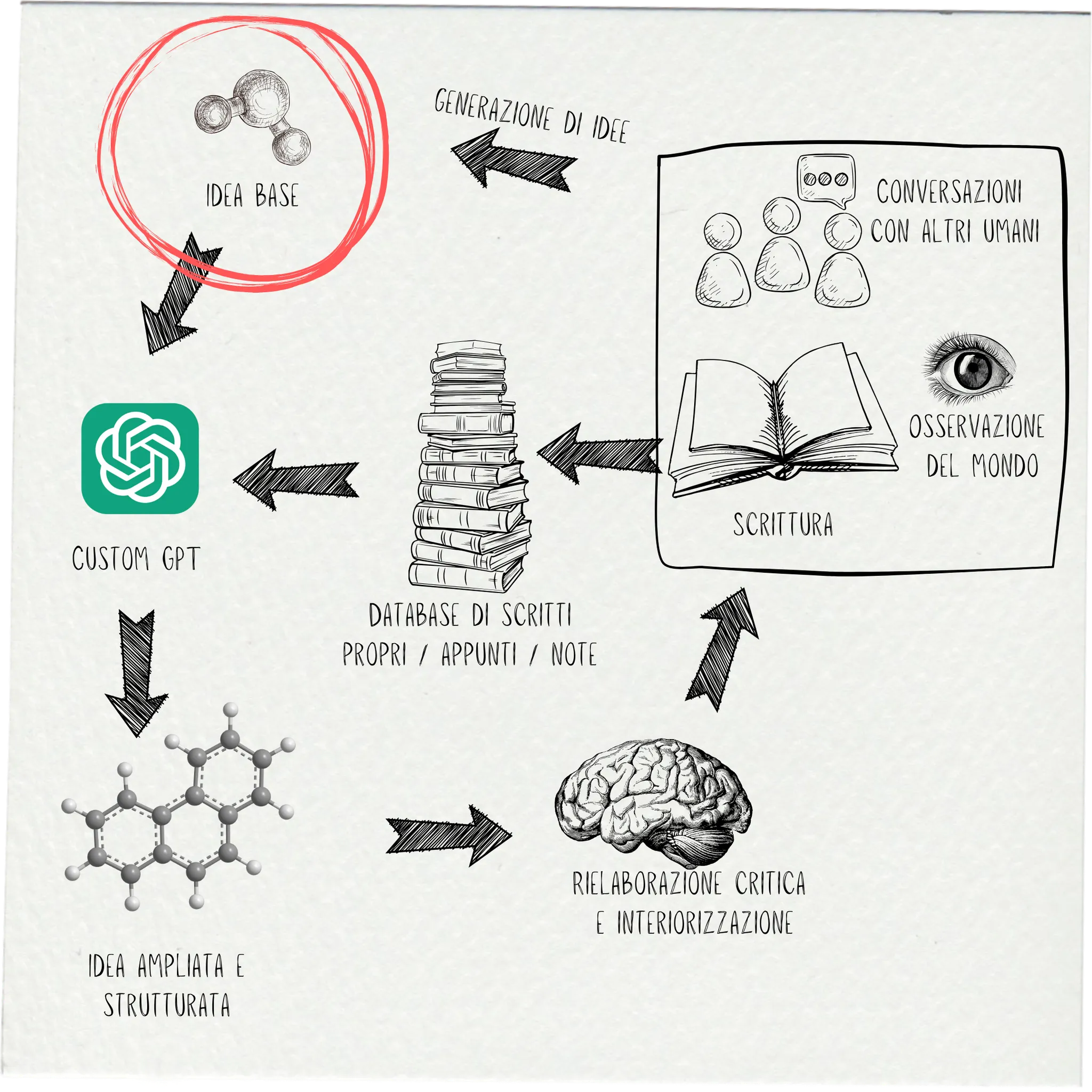
With these advantages in mind, here is the scheme I propose.
Phase 1: Idea enlargement
The starting point can be a basic concept, a simple idea, a momentary intuition — the kind of thing that comes to mind while taking a shower or going for a solitary walk. For example, the thesis of this article.
I then developed a series of questions that can help turn a momentary intuition into a more articulated and solid structure of thought. The process is based on ChatGPT. You can use the basic version. For convenience, I built a custom assistant with instructions to answer me in a way more consistent with the style and tone I want. I named it Sokrates (like the famous Brazilian footballer). You can test it here: 🏛️ SOKRATES
The questions. With your rough idea in mind, here is a series of questions I recommend asking:
- “What do you think of this reasoning…? Help me rephrase this thought of mine in a more structured, clear and orderly way, with more academic vocabulary.” — Expected outcome: ChatGPT rephrases the original idea. It usually trivialises a little. It’s useful to understand whether the idea has ground to grow on, or is a rehash of a more trivial concept.
- “Help me structure my argument better. Can you tell me if there are any philosophers, writers or essayists who have dealt with this topic and whom I should quote? Who are they and what is their view?” — This places your idea in the existing debate. There may be (spoiler: there almost always are) writers who covered your topic before you, and did it better. Worth a read.
- “Try to make counter-objections to my idea. Criticise it. In doing so, if you can, quote texts and authors who have taken positions opposite to mine.” — This is the most important question. ChatGPT is usually very good at understanding the key points of an argument and dismantling them. You may need to insist a little. The debate that emerges is always very interesting.
- “How would [author name] have approached this issue?” — A common method in design thinking exercises. It’s also fun: it feels like having a dialogue with authors who died centuries ago.
Phase 2: Critical reworking
By now you should have come up with many ideas — some confused, some banal, but which have certainly strengthened your initial thought. You should also have collected further reading suggestions.
The key thing here is to rework what you have gathered. Reworking means activities such as:
- Writing down your thoughts
- Keeping a notebook with reading and study recommendations and key concepts
- Schematising ideas and counter-objections
- Talking about them with friends and asking what they think
- Observing the world and looking for elements in real life that reinforce or deny the insights gathered through dialogue with the AI
Phase 3: Writing and strengthening the model
Writing is an essential part of this process.
First, because writing is the visual reorganisation of a thought: it is one of the most effective methods for memorising ideas and concepts and organising them in your head. It requires time and patience. See it as an exercise: the more time you spend writing words and diagrams on a sheet of paper, the easier it will be to write, reason and memorise in the future. Above all: the more order there is in your head, the better.
Second, written text is the preferred input for language AI models, allowing them to further rework what has been written and give increasingly refined answers. A sort of continuous dialogue forms — one that never starts from scratch but continues for months, like ongoing university lectures.
For this phase I prefer paper (with its materiality and analogue timing) to writing on the computer. I then retype what I’ve written so I can feed it to the AI.
Possible interactions with the AI:
- Lexical refinement. “Can you rewrite this article in a more academic — and a more popular — style?” In diary writing and personal notes we often use colloquial, inexact, imprecise terms. The AI suggests more precise, more fitting terminology. It’s also an exercise to improve your everyday language. Words are ideas: the more precise the words we use, the more order and precision we will have in our thoughts.
- Integrating the model with your own database of writings. It helps to put all your writing in a public library. In my case I use Notion. In the back-end of 🏛️ SOKRATES I inserted a reference to my articles, and in the prompt I indicated:
“When you can and when required, refer to what Gabriele Sirtori has written in the articles you can find at this link: [insert url]”
This is very useful because, at the end of a piece, you can feed it back and ask: “Can you see how what I just wrote is consistent with the other texts written by Gabriele Sirtori?” or “Which of Gabriele Sirtori’s other writings are related to this text, and how could they be cited as part of a single, more complex and organised train of thought?”
Phase 4: Conclusion and new iterations
At this point you start to structure a single, complex train of thought, made of many aspects and many citations. With time, and with new ideas that gradually arise, this train of thought becomes stronger and gains uniqueness and robustness.
Above all, you will be able to form a second brain — trained and educated on your ideas — which, when you feel confused, you can sometimes ask: “What do you think, since you know what I think?”