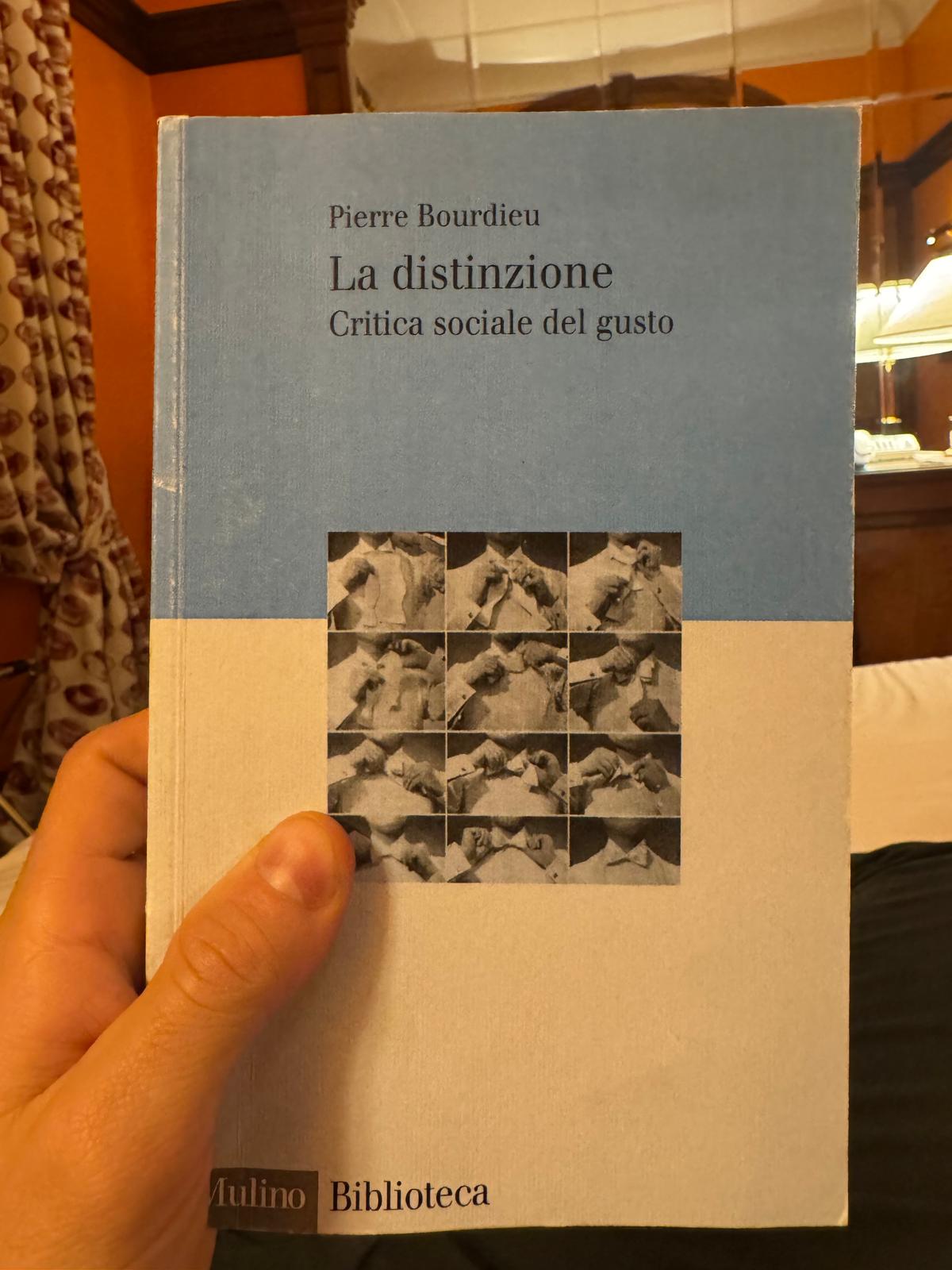
Distinction — A Social Critique of the Judgement of Taste (P. Bourdieu, 1979)
Part of the Summing Up project: periodic summaries and reviews of business books.
1. INTRODUCTION AND CENTRAL THESIS
Main idea
- Taste is neither natural nor spontaneous, but is socially constructed
- Aesthetic and cultural preferences reflect and reproduce social hierarchies
- Culture functions as an instrument of social distinction between classes
Aim of the work
- To unmask the illusion that taste is a matter of personal sensibility
- To demonstrate how cultural choices legitimize social inequalities
2. KEY CONCEPTS
A) Habitus
- Definition: a system of durable and transferable dispositions acquired through socialization
- Functions as an embodied “grammar” that generates practices, tastes, and lifestyles
- It is the product of social position and personal history
- Operates in a pre-reflexive way (automatic, not fully conscious)
- Example: the way of eating, walking, speaking, appreciating art
Characteristics of the habitus:
- Embodied: it becomes part of the body and the mind
- Durable: it resists change
- Transferable: it applies to different domains of life
- Generative: it produces infinite practices adapted to situations
B) Capital (in its forms)
1. Economic capital
- Material and financial resources
- Income, property, goods
2. Cultural capital (the most important for Bourdieu)
- Embodied form: knowledge, skills, cultural dispositions
- Objectified form: possession of cultural goods (books, works of art, instruments)
- Institutionalized form: educational qualifications, diplomas, certifications
3. Social capital
- A network of relationships, connections, group memberships
4. Symbolic capital
- Prestige, recognition, reputation
- It is the legitimized form of the other capitals
C) Social field
- A structured space of social positions
- An arena of struggle for the accumulation and control of capital
- Each field has its own specific rules (artistic, academic, economic field, etc.)
D) Symbolic violence
- The imposition of meanings as legitimate
- The concealment of the power relations that underlie authority
- The dominated classes internalize the criteria of evaluation of the dominant classes
- It is not perceived as violence, but as the natural order
3. SOCIAL SPACE AND CLASSES
Structure of social space
Bourdieu identifies three broad classes on the basis of the total volume of capital and the composition of capital:
A) Dominant class
Characteristics:
- High volume of total capital
- Divided into two fractions:
1. Dominant fraction (high economic capital)
- Entrepreneurs, industrialists, managers
- Taste for ostentatious luxury, for the monumental
- Preferences: rich cuisine, prestigious cars, villas
2. Dominated fraction (high cultural capital)
- Intellectuals, artists, university professors
- “Pure” taste or the aesthetic of distance
- Appreciation of avant-garde art, auteur cinema
- Rejection of the commercial and the “vulgar”
B) Middle class (petite bourgeoisie)
Characteristics:
- Medium volume of capital
- Cultural goodwill: aspires to the tastes of the upper classes
- An attitude of learning and deference toward legitimate culture
- Cultural pretension: seeks to distinguish itself from the popular classes
- Preferences: “middlebrow” culture (museums, classical theater), self-education
Strategies:
- Investment in the education of their children
- Conformism and respectability
- A tendency toward asceticism (sacrifice in order to improve one’s social position)
C) Popular class
Characteristics:
- Low volume of capital (especially cultural)
- Aesthetic of necessity: functional and practical taste
- Preference for what is substantial, abundant, useful
- Distance from legitimate culture (museums, opera perceived as “not for us”)
Popular tastes:
- Realism in art (preference for comprehensible works)
- Light music, variety shows, catchy melodies
- Popular sports (football, boxing)
- Convivial sociability (parties, banquets)
4. TASTE AS DISTINCTION
Legitimate taste (dominant class)
Characteristics of the pure aesthetic:
- Distance: separation between form and function
- Disinterest: appreciation “for its own sake”, without practical ends
- Formalism: attention to form rather than to content
- The ability to appreciate difficult, experimental, avant-garde works
Examples:
- Abstract art vs. figurative art
- Auteur cinema vs. commercial cinema
- Refined cuisine vs. hearty cuisine
- Jazz, classical music vs. popular music
Middlebrow taste (middle class)
- “Middlebrow” and popularizing culture
- Reverential respect for high culture
- Moderate eclecticism: controlled openness
- The desire to conform to legitimate canons
The taste of necessity (popular class)
Principles:
- Functionality: “what is it for?”
- Substance: preference for the concrete, the nourishing, the robust
- Rejection of formalism: whatever is not immediately comprehensible is rejected as pretentious
- The aesthetic of “common sense”
5. AREAS OF APPLICATION
A) Art and culture
- Photography: popular class (family keepsake photos) vs. dominant class (photography as art)
- Painting: popular realism vs. the abstraction of the elites
- Reading: romance novels vs. experimental literature
- Museums: attendance correlated with cultural capital
B) The body and self-presentation
- Popular class: functional body, physical strength, strength sports
- Middle class: care of the body for health and respectability
- Dominant class: slim, elegant body, individual sports (tennis, skiing, golf)
Food:
- Popular: abundance, fats, red meat
- Bourgeois: lightness, balance, exotic and refined foods
C) Language and manners
- Accent, vocabulary, posture
- Ease vs. embarrassment in formal contexts
- Elaborated vs. restricted linguistic codes
D) Furnishing and the home
- Different styles reflect social positions
- Functional objects vs. decorative objects
- Public spaces (living room) vs. privileged private spaces
6. MECHANISMS OF SOCIAL REPRODUCTION
The role of education
- School: apparently neutral, in reality it privileges those who already possess cultural capital
- Hidden curriculum: presupposes familiarity with legitimate culture
- Those who come from cultured families have an invisible advantage
- Educational qualifications legitimize and transform cultural privilege into individual merit
The illusion of the natural gift
- “Talent” and “refined taste” are presented as natural
- In reality they are the product of a long process of family inculcation
- This naturalization conceals the social origin of these competencies
Strategies of distinction
- The dominant classes constantly change their tastes when these are adopted by the lower classes
- A mechanism of flight upward: maintaining social distance
- Example: when a musical genre becomes popular, the elites abandon it
7. CRITIQUES AND LIMITS OF THE WORK
Strengths
- Solid empirical analysis (thousands of questionnaires)
- Reveals the hidden mechanisms of social reproduction
- Links taste, culture, and power in an innovative way
Critiques received
- Excessive determinism: little room for individual agency
- Eurocentrism: a study limited to France in the 1960s–70s
- Underestimation of resistance: the popular classes can develop alternative cultures
- Gender: scant attention to gender differences
- Evolution: some dynamics have changed in the digital era (an apparent democratization of culture)
8. APPLIED CONCEPTS FOR ANALYSIS
How to apply Bourdieu to cultural analysis:
Questions to ask:
- Who has access to this cultural practice?
- What capital is required to appreciate it?
- Which social distinctions are being marked?
- How is this hierarchy of tastes legitimized?
- Who determines what counts as “good taste”?
Example of analysis:
- Netflix vs. arthouse cinema: the distribution of capital and preferences
- Fast food vs. Michelin-starred restaurants: distinction through food
- Streetwear vs. haute couture: fashion as a marker of class
9. MAIN CONCLUSIONS
Fundamental theses to remember:
- Taste is social, not individual: aesthetic preferences are determined by one’s position in the social structure
- Culture is an instrument of power: it serves to legitimize and reproduce social hierarchies
- Distinction is relational: tastes are defined in opposition to other tastes
- The habitus mediates between structure and action: embodied dispositions connect social position and everyday practices
- Symbolic violence is invisible: the dominated accept the criteria of evaluation of the dominant as legitimate
- Education reproduces inequalities: while appearing meritocratic, it privileges those who start out advantaged
Relevance of the thought today
- New forms of distinction in the digital era (influencers, cultural capital on social media)
- The persistence of class dynamics in contemporary culture
- Debates on high/low culture still relevant
10. KEY QUOTATIONS
- “Taste classifies, and it classifies the classifier”
- “Social distinction asserts itself in aesthetic distinction”
- “There are no disinterested tastes: every preference is a strategy of distinction”
- “Art and cultural consumption are predisposed to fulfil a social function of legitimating social differences”
FINAL SUMMARY SCHEMA
CAPITAL → HABITUS → TASTES → PRACTICES → DISTINCTION → SOCIAL REPRODUCTION
The resources one possesses form dispositions that generate preferences that translate into behaviors that mark differences that perpetuate hierarchies.