Digital marketing and local politics: a winning couple
In May 2019, in Barzago, a municipality in the province of Lecco, elections were held to choose the mayor and the council. I was asked to take part actively as a candidate for the town council on the civic centre-left list “Il Paese Barzago”. I preferred a more interesting role: taking care of communication during the campaign.
The challenge: a centre-left list in a right-leaning town
The municipal elections of 29 May 2019, you may recall, were held together with the European Parliament elections. In that vote, in Barzago, the centre-right and right-wing parties together took more than 80% of the votes. Almost a plebiscite.
The mayoral count would take place the day after the European results were announced. All the ingredients were there to fear the worst: the mass vote for Salvini’s Lega (which backed the opposing list), a candidate, Mirko Ceroli, with a past as councillor but no leadership experience, and a list made up of many young people — the lowest average age in the whole province.
“Well done, everyone — at least we tried,” we were about to say.
The result, instead, came unexpectedly, in the form of a phone call from my friend Isaco. “Gabri,” he tells me, “we won. Mirko is the new mayor.”
I couldn’t believe my ears: despite the Bulgarian percentages for the centre-right in the European vote, 53.9% of Barzago’s voters had chosen him to lead the town.
Setting up the campaign: starting from values
The secret of the victory, I believe, was a campaign that was very consistent from the start, built not so much on electoral promises as on the key values the list carried.
From a few chats with voters, in fact, I had understood something important.
At this level, people don’t vote for a mayor to fix the road or the sewer under their house. They look for someone they can trust, who shares with them a few — just a few — key values.
So this had to be the watchword: VALUES.

The photo you see above is an exercise I had the list do: I asked them to divide a large sheet of paper in two and write “our values” on one side and “the opponent’s values” on the other. The next step: write on post-its some values a mayor should have and place them on the sheet. Depending on position, they’d be “exclusive values” of one list or the other, or shared values.
The result? In less than an hour of discussion I obtained what in marketing is called a unique selling proposition (here also the key value proposition): the set of attributes and values that detach my product (my list) from the competition and make it unique and inimitable.
In particular, three values emerged: Listening, Competence, Willingness.
Easy to say, difficult to apply, even harder to communicate.
Listening, competence, willingness: how to communicate them?
Communicating the “competence” of a list is difficult. How to do it? This was the intuition: don’t quote the group — start from the individuals.
Put that way, everything became easier: Listening = the ability to get in tune with the average inhabitant of the town Competence = one’s own experience and knowledge, but also one’s own passions Willingness = the courage to put your face to it, to go out into the street and touch the reality of the town.
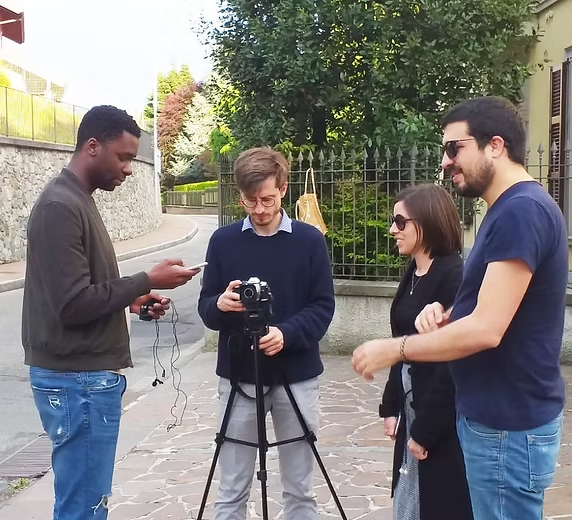
Thus was born a video series called “my place of the heart”: each candidate was asked to choose a place in the town that mattered to them and, from there, tell something about themselves and what they could bring to the Council.
Many candidates were awkward in front of the camera, but this — I think — added a touch of likeability and consonance with the average voter.
The videos were released every 2-3 days. Here is Francesca Mantonico’s video.
A convincing, professional pitch
Individuality is all well and good, but sooner or later the moment had to come when the list presents itself as a whole and tells its programme.
That presentation was taken care of in the smallest detail. The watchwords: 1. “be interesting and enjoyable” and 2. “values, not promises”.
The big novelty compared to previous years was the careful choice of guests. In the past, the custom was to invite some high-level local politician who would give a small speech with a few generic words of support, trying to remember the candidates’ names. But how can such a person represent “competence”, “listening” and “willingness”?
So we broke with tradition and invited:
- the long-time mayor of a neighbouring municipality
- a manager of a large local company, a member of Federmanager.
Two “Mr. Nobodies” of politics, but decisive for two issues voters cared about: security (the invited mayor is a pioneer of so-called “neighbourhood watch”) and the fear of unemployment (in the following months, with Federmanager, we organised free courses on CV writing and job-interview preparation).
Here are some pictures of the evening.


c’ero anch’io!
The final rush: emotional videos to strike the voter’s heart
Back to square one: the voter doesn’t want promises or philosophies — they want to be able to trust.
That’s how, for the last communication before the vote, we bet everything on emotion.
On one hand, we asked the list members to take part in a video where each recited a fragment of an inspiring message. Here’s the result.
<
On the other, we asked some supporters to “put their faces on it”.
Reliability, in fact, comes above all from observing the behaviour of others we consider “like us”. “If they do it,” says our head, “why shouldn’t I trust them?”
So here is a second video, released close to the first, just days before the vote. The participants are all people known in the town and more or less close to the list. They all said something unprepared, spontaneous — and, I think, in many cases their sincerity and affection are clearly visible.
Winning trust: the hardest thing
What did I learn?
- winning a person’s trust is extremely difficult
- to do it you need to use all the logical and subconscious circuits you can reach
- appealing to rationality alone is not enough
- better to talk about values, not attributes or functions (for products) or promises and programmes (for political ideas)
